

How the Perimenopause Sets Your Brain on Fire – Ciara Wright PhD at the Functional Medicine Conference
October 2, 2026Bone is living tissue that is broken down and rebuilt throughout life, and a DEXA scan may only show the result years later. Turnover markers such as P1NP and NTx show what your bones are doing right now. 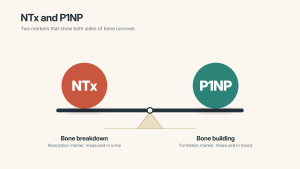
Constant renewal
Your skeleton is renewed constantly. Cells called osteoclasts dissolve small pockets of old bone, and osteoblasts fill them with fresh collagen that then mineralises. In a healthy adult the two are closely matched, so bone mass holds steady.
The balance tips when breakdown outpaces rebuilding. This happens most sharply in the years around menopause as oestrogen falls. Ageing, low protein or energy intake, chronic inflammation, malabsorption such as coeliac disease, thyroid or parathyroid issues, and long term corticosteroid use can all impact in a negative way here.
A DEXA scan measures bone mineral density and remains the standard for diagnosing osteoporosis. It is a picture of bone already built or lost. Density shifts slowly, so a repeat scan usually needs one to two years before it can show a real change.
P1NP and Ntx – the two sides of the story
Turnover markers are collagen fragments released as bone is built and broken down. Measuring one of each type shows both halves of the remodelling cycle.
| Marker | What it reflects | Sample | Where it comes from |
| P1NP (procollagen type 1 N-terminal propeptide) | Bone formation | Blood | Clipped off new type 1 collagen as osteoblasts lay it down |
| NTx (N-terminal telopeptide of type 1 collagen) | Bone resorption | Urine, corrected for creatinine | Released as osteoclasts break down mature, cross-linked collagen |
The two tests are most helpful when done together. After menopause both usually rise, because formation speeds up to chase resorption without quite catching it however. The higher the turnover, the faster bone tends to be lost.
However, these markers do not diagnose osteoporosis and are not part of fracture risk calculators, so they sit alongside a DEXA scan and never replace it.
The value of testing
- You find out sooner whether your plan is working. Bone markers respond within three to six months, whereas a repeat DEXA scan can take a couple of years to show a difference. In one study from The Metabolic Bone Centre in Sheffield, the drop in urinary NTx at four months went hand in hand with the improvement in spine density seen at 18 months.
- You can see which way things are heading. A DEXA scan tells us where your bones are today. Turnover markers tell us whether you are holding steady or not, and in postmenopausal women raised markers are linked with a higher risk of fracture.
- It can prompt us to look for the reason why. If turnover is higher than we would expect, or doesn’t settle, something is usually driving it. In clinic that might mean checking your nutrient status, such as vitamin D, looking at thyroid function, or exploring gut health and how well you are absorbing your food. These are all tests we can arrange for you.
- It gives us a starting point. One result on its own tells us very little. It is the change between tests that matters, which is why a baseline is so useful.
What can you do right now?
Testing shows where you stand. These steps are key in changing the picture, and you can start them today.
- Load your skeleton. Progressive resistance and impact exercise has the strongest evidence of any lifestyle measure for improving bone density after menopause.
- Eat enough protein. Bone is roughly half protein by volume, and higher intakes are linked with better density when calcium is adequate.
- Get calcium from food first and correct low vitamin D. Supplements help most where intake or blood levels are low.
- Eat the supporting nutrients. Magnesium and vitamin K2 work alongside calcium and vitamin D in building bone. Find magnesium in leafy greens, nuts, seeds and pulses, and K2 in fermented foods, aged cheese and egg yolks.
- Go easy on alcohol and avoid smoking. These are both established risk factors for fracture.
The bottom line
If you’re wondering whether your bones are strong, don’t wait for a fracture (or a diagnosis) to find out.
A combination of DEXA scans, bone turnover tests, and targeted nutrition gives you the full picture — and the power to protect your health proactively.
Would you like to speak to one of our Nutritional Therapists? Get in touch with us today or share this post with someone who could benefit from evidence-based nutritional support.