

Bone health: what testing adds to the pictureBone health: what testing adds to the pictureBone health: what testing adds to the pictureBone health: what testing adds to the picture
  • Our Clinics
    • Dublin
    • How It Works
  • Conditions
      • Autoimmune Diseases
      • Bone Health & Osteoporosis
      • Egg Quality
      • Endometriosis
      • Fibroids
      • Food Intolerances
      • Hashimoto’s Disease
      • Heart health and Cardiovascular
      • Histamine Intolerance/ MCAS
      • IBS and Digestive Issues
      • Immune related infertility
      • Irregular periods
      • IVF Support
      • Long Covid
      • Male Fertility and Sperm DNA Fragmentation
      • Pregnancy
      • ME/CFS
      • Menopause
      • PMOS (formerly PCOS)
      • Perimenopause
      • PMS
      • Recurrent Miscarriage
      • SIBO (Small Intestinal Bacterial Overgrowth)
      • Thyroid Health
      • Trying to conceive
      • Weight Management
  • Functional Medicine Tests
      • Adrenal Stress test
      • Advanced Immune Test
      • Advanced Iron studies and Anaemia
      • Advanced Thyroid Test
      • AMH Ovarian Reserve Test
      • Amino Acid Profile
      • At Home Whole Blood Nutrient Profile
      • Basic Health Reviews
      • Bioactive B vitamins
      • Fasting Insulin – Insulin Resistance
      • Bone Profile
      • Bone Turnover Test
      • Candida Tests
      • Continuous Glucose Monitor
      • CRP (high sensitivity) Blood Test
      • DNA Blue Print Test
      • DUTCH Comprehensive Hormone Test
      • Fertility Nutritional Profile
      • Fibrinogen
      • Food Intolerance – Food Map IgG Test
      • Functional Nutritional Profile
      • Gut Health & Microbiome – GI Map Test
      • Heart Health Profile Blood Test
      • Homocysteine
      • Hormone Blood Test
      • Hormone DNA Risk Profile
      • Inflammation and Leaky Gut
      • Iodine Test
      • Lactose Intolerance Test
      • Lyme Disease: Tickborne Illness and Co-infections
      • Male Microbiome – Semen Microbiome Test
      • Oral Microbiome
      • Organic Acids Test (OAT)
      • Small Intestinal Bacterial Overgrowth (SIBO) test
      • Sperm DNA fragmentation test
      • Thyroid Nutrient Profile
      • Vaginal Health Test
      • Viral panel
      • Vitamin D blood test
  • Pricing
  • Our Research
  • Corporate Wellness
  • Resources
    • Articles
    • TV & Heather Leeson
    • Webinars & Podcasts
  • About
Book Now
✕
Ciara Wright speaking at the Functional Medicine Conference
How the Perimenopause Sets Your Brain on Fire – Ciara Wright PhD at the Functional Medicine Conference
October 2, 2026

Bone health: what testing adds to the picture

Categories
  • Articles
  • Bone Health
  • Healthy Eating
Tags
  • bone health
  • osteoporosis

Bone is living tissue that is broken down and rebuilt throughout life, and a DEXA scan may only show the result years later. Turnover markers such as P1NP and NTx show what your bones are doing right now.
Constant renewal 

Your skeleton is renewed constantly. Cells called osteoclasts dissolve small pockets of old bone, and osteoblasts fill them with fresh collagen that then mineralises. In a healthy adult the two are closely matched, so bone mass holds steady.

The balance tips when breakdown outpaces rebuilding. This happens most sharply in the years around menopause as oestrogen falls. Ageing, low protein or energy intake, chronic inflammation, malabsorption such as coeliac disease, thyroid or parathyroid issues, and long term corticosteroid use can all impact in a negative way here.

A DEXA scan measures bone mineral density and remains the standard for diagnosing osteoporosis. It is a picture of bone already built or lost. Density shifts slowly, so a repeat scan usually needs one to two years before it can show a real change.

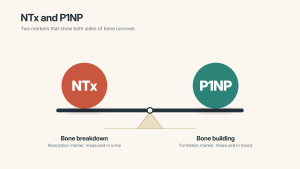
P1NP and Ntx – the two sides of the story

Turnover markers are collagen fragments released as bone is built and broken down. Measuring one of each type shows both halves of the remodelling cycle.

Marker What it reflects Sample Where it comes from
P1NP (procollagen type 1 N-terminal propeptide) Bone formation Blood Clipped off new type 1 collagen as osteoblasts lay it down
NTx (N-terminal telopeptide of type 1 collagen) Bone resorption Urine, corrected for creatinine Released as osteoclasts break down mature, cross-linked collagen

The two tests are most helpful when done together. After menopause both usually rise, because formation speeds up to chase resorption without quite catching it however. The higher the turnover, the faster bone tends to be lost.

However, these markers do not diagnose osteoporosis and are not part of fracture risk calculators, so they sit alongside a DEXA scan and never replace it.

The value of testing
  • You find out sooner whether your plan is working. Bone markers respond within three to six months, whereas a repeat DEXA scan can take a couple of years to show a difference. In one study from The Metabolic Bone Centre in Sheffield, the drop in urinary NTx at four months went hand in hand with the improvement in spine density seen at 18 months.
  • You can see which way things are heading. A DEXA scan tells us where your bones are today. Turnover markers tell us whether you are holding steady or not, and in postmenopausal women raised markers are linked with a higher risk of fracture.
  • It can prompt us to look for the reason why. If turnover is higher than we would expect, or doesn’t settle, something is usually driving it. In clinic that might mean checking your nutrient status, such as vitamin D, looking at thyroid function, or exploring gut health and how well you are absorbing your food. These are all tests we can arrange for you.
  • It gives us a starting point. One result on its own tells us very little. It is the change between tests that matters, which is why a baseline is so useful.
What can you do right now?

Testing shows where you stand. These steps are key in changing the picture, and you can start them today.

  • Load your skeleton. Progressive resistance and impact exercise has the strongest evidence of any lifestyle measure for improving bone density after menopause.
  • Eat enough protein. Bone is roughly half protein by volume, and higher intakes are linked with better density when calcium is adequate.
  • Get calcium from food first and correct low vitamin D. Supplements help most where intake or blood levels are low.
  • Eat the supporting nutrients. Magnesium and vitamin K2 work alongside calcium and vitamin D in building bone. Find magnesium in leafy greens, nuts, seeds and pulses, and K2 in fermented foods, aged cheese and egg yolks.
  • Go easy on alcohol and avoid smoking. These are both established risk factors for fracture.
The bottom line

If you’re wondering whether your bones are strong, don’t wait for a fracture (or a diagnosis) to find out.

A combination of DEXA scans, bone turnover tests, and targeted nutrition gives you the full picture — and the power to protect your health proactively.

Would you like to speak to one of our Nutritional Therapists? Get in touch with us today or share this post with someone who could benefit from evidence-based nutritional support.

Share

Related posts

Ciara Wright speaking at the Functional Medicine Conference

Functional Medicine Conference

October 2, 2026

How the Perimenopause Sets Your Brain on Fire – Ciara Wright PhD at the Functional Medicine Conference


Read more
September 16, 2026

Free digestive support this month


Read more
Ciara Wright PhD podcast Long Covid
June 2, 2026

Podcast with Ciara Wright PhD – Long Covid


Read more

Categories

  • Articles (33)
  • Bone Health (4)
  • Brain health (3)
  • Digestion and the Gut Microbiome (12)
  • Fertility (12)
  • Healthy Eating (24)
  • Heart Health (3)
  • Hormones (12)
  • Immune (6)
  • Liver Health (2)
  • Long Covid (4)
  • Media (26)
  • Microbiome (8)
  • Perimenopause and Menopause (6)
  • Pregnancy (5)
  • Stress and Lifestyle (6)
  • Tests (3)
  • Thyroid (2)
  • Vaginal Microbiome (1)
  • Vegan (1)
  • Webinars & Podcasts (8)
  • YouTube (26)

Search Articles

✕

Recent Articles

  • bone showing porous nature of bones in osteoporosis
    Bone health: what testing adds to the picture
    October 8, 2026
  • Ciara Wright speaking at the Functional Medicine Conference
    How the Perimenopause Sets Your Brain on Fire – Ciara Wright PhD at the Functional Medicine Conference
    October 2, 2026
  • Free digestive support this month
    September 16, 2026
  • PMOS: Looking Beyond Fertility and Understanding Your Metabolic Health
    August 30, 2026
  • PCOS is Now PMOS: What the Name Change Means for Women’s Health
    August 30, 2026

Get Started

Book a consultation or request a free call back

Book Your Call Today

Our Clinics

Positive Nutrition
10 Orwell Road,
Rathgar,
Dublin,
D06 T265
Ireland

Contact

01 2655977

clinic@positivenutrition.ie

Sign up for the Positive Nutrition Newsletter

* = required field

Your Privacy

We’re committed to providing you with the best possible customer service experience. Your privacy is important to us. Upon your consent, Positive Nutrition shall retain your personal data to inform you of new services or special offers. Your personal data will never be forwarded to any third parties. This website uses Cookies. Continued use of the site will be deemed as your acceptance of this necessity. Read our full Privacy Policy.

© 2024 Positive Nutrition Ltd. All Rights Reserved. Website by JET Design.
    Book Now
      Manage Consent
      To provide the best experiences, we use technologies like cookies to store and/or access device information. Consenting to these technologies will allow us to process data such as browsing behavior or unique IDs on this site. Not consenting or withdrawing consent, may adversely affect certain features and functions.
      Functional Always active
      The technical storage or access is strictly necessary for the legitimate purpose of enabling the use of a specific service explicitly requested by the subscriber or user, or for the sole purpose of carrying out the transmission of a communication over an electronic communications network.
      Preferences
      The technical storage or access is necessary for the legitimate purpose of storing preferences that are not requested by the subscriber or user.
      Statistics
      The technical storage or access that is used exclusively for statistical purposes. The technical storage or access that is used exclusively for anonymous statistical purposes. Without a subpoena, voluntary compliance on the part of your Internet Service Provider, or additional records from a third party, information stored or retrieved for this purpose alone cannot usually be used to identify you.
      Marketing
      The technical storage or access is required to create user profiles to send advertising, or to track the user on a website or across several websites for similar marketing purposes.
      • Manage options
      • Manage services
      • Manage {vendor_count} vendors
      • Read more about these purposes
      View preferences
      • {title}
      • {title}
      • {title}